

According to the Appraisal Foundation, USPAP compliance is mandatory for all federally related transactions in the United States, affecting millions of property valuations annually. When you engage a state-certified appraiser, the resulting document must adhere to strict ethical and performance standards to be considered legally defensible. This guide details the exact components required for a valid report.
Defining USPAP and Its Authority
Uniform Standards of Professional Appraisal Practice (USPAP) is the generally accepted and recognized ethical and performance standards for the appraisal profession in the United States. USPAP is the gold standard for property valuation integrity. It is developed and administered by The Appraisal Foundation, a private, non-profit organization authorized by Congress.
For any real estate appraisal to be accepted by lenders, courts, or government agencies, it must comply with these standards. New Jersey Real Estate Appraisal Group ensures that every valuation report we produce meets these rigorous criteria. This compliance protects all parties involved, from the homeowner to the bank, by guaranteeing that the opinion of value is derived through a transparent and logical process.
Understanding the source of these standards is critical. The Appraisal Foundation operates under the authority of the Appraisal Subcommittee of the Federal Financial Institutions Reform, Recovery, and Enforcement Act. This federal oversight ensures that appraisal practices remain consistent and reliable across state lines.
Understanding Report Formats
USPAP does not mandate a single report format. Instead, it allows appraisers to choose the appropriate level of detail based on the client's needs and the complexity of the assignment. The three primary formats are:
- Appraisal Report: This is the most common format for residential properties. It contains a summary of the information, the appraiser's opinions, and conclusions. It is suitable for most refinancing and purchase transactions.
- Summary Appraisal Report: Often used for more complex commercial or land valuations, this report provides a more detailed narrative of the data and analysis.
- Restricted Appraisal Report: This format is used when the client is the only intended user and the value is relatively straightforward. It contains less detail than the other two formats.
At New Jersey Real Estate Appraisal Group, we tailor the report format to the specific requirements of your transaction. Whether you need a detailed commercial valuation or a standard residential appraisal, we ensure the output matches the intended use.
Core Content Requirements
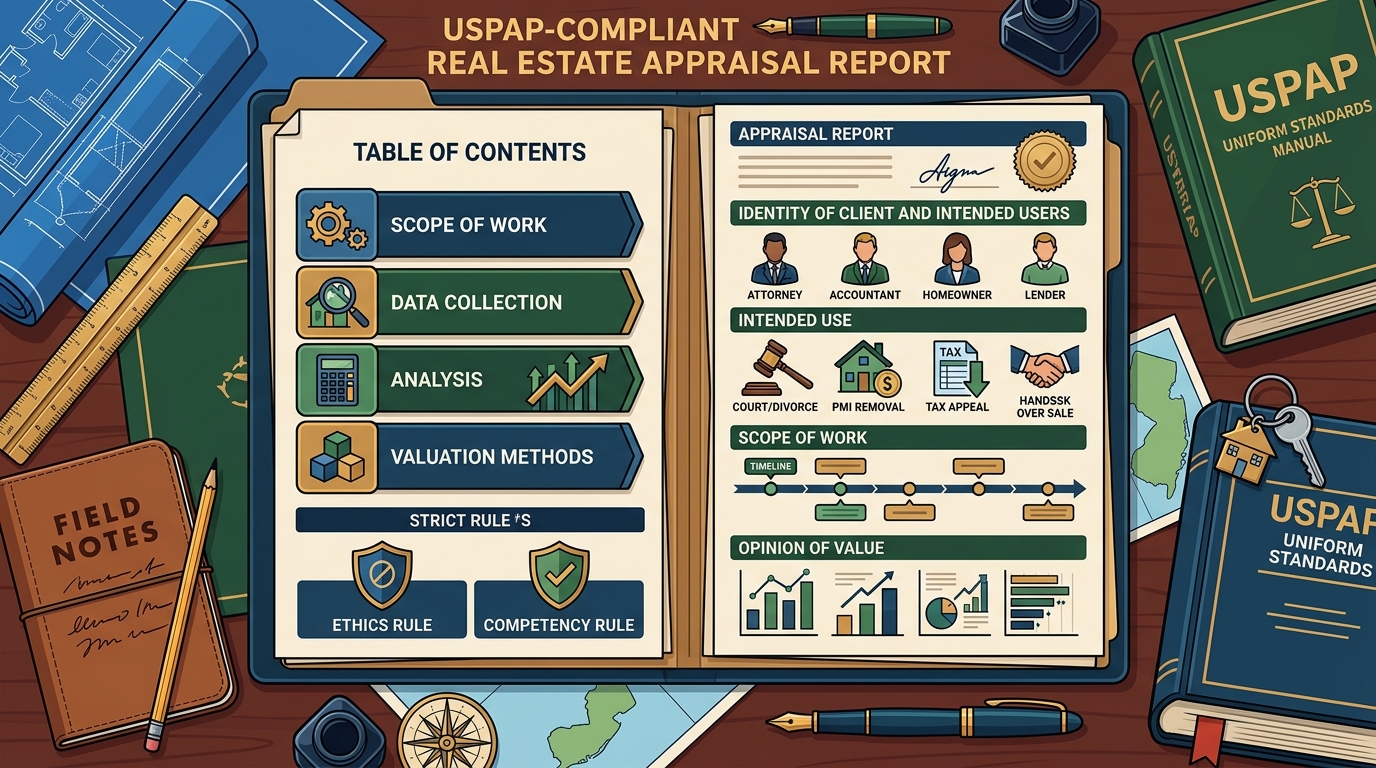
Regardless of the format chosen, every USPAP-compliant report must contain specific elements to be valid. These elements ensure that the reader can understand the logic behind the final value conclusion.
1. Identification of the Property
The report must clearly identify the real property being appraised. This includes the physical location, legal description, and any relevant zoning classifications. For properties in Atlantic County or Bergen County, local zoning nuances can significantly impact value, so precise identification is vital.
2. Definition of Value
The report must state the type of value being estimated. In most cases, this is Market Value, defined as the most probable price a property should bring in a competitive and open market. Other definitions, such as Fair Market Value or Investment Value, may be used depending on the assignment.
3. Highest and Best Use Analysis
A critical component of any appraisal is the Highest and Best Use (HBU) analysis. Highest and Best Use is the reasonably probable and legal use of vacant land or an improved property that is physically possible, appropriately supported, financially feasible, and results in the highest value. This analysis determines how the property should be utilized to maximize its worth.
4. Scope of Work
The appraiser must disclose the scope of work performed. This includes the extent of the inspection, the data sources used, and the methods applied. Transparency in the scope of work allows the reader to assess the reliability of the appraisal.
5. Data and Analysis
The report must present the data and analysis that support the appraiser's opinions. This includes:
- Comparable Sales: Recent sales of similar properties in the vicinity.
- Market Conditions: Trends in supply, demand, and pricing.
- Cost Approach: The estimated cost to replace the property, minus depreciation.
- Income Approach: For income-producing properties, the capitalization of net operating income.
We utilize cutting-edge data tools to ensure that our comparable sales are accurate and relevant. This data-driven approach minimizes bias and enhances the credibility of the final valuation.
The Appraiser's Certification
Every USPAP-compliant report must include a certification signed by the appraiser. This certification is a legal statement that attests to the appraiser's independence, objectivity, and adherence to USPAP standards. It typically includes the following statements:
- The appraiser has no present or prospective interest in the property.
- The appraiser has not performed appraisal services on the property within the past two years.
- The appraiser's compensation is not contingent on the reporting of a predetermined value.
- The appraiser has made a personal inspection of the property, or if not, states why.
- The appraiser has examined all available relevant data and made all necessary inspections.
This certification is not merely a formality. It holds the appraiser legally accountable for the accuracy and integrity of the report. At NJREAG, our state-certified appraisers take this responsibility seriously, ensuring that every report we issue is defensible in court or to regulatory bodies.
Ensuring Legal Defensibility
In New Jersey, property appraisals are often required for tax appeals, divorce settlements, and estate planning. In these high-stakes scenarios, the defensibility of the appraisal is paramount. A USPAP-compliant report provides a clear audit trail that can withstand scrutiny.
For example, in Camden County tax appeals, the Board of Tax Appeals requires detailed justification for any deviation from assessed values. Our reports include comprehensive market analysis and comparable sales data to support our conclusions.
Similarly, in divorce proceedings, an unbiased and compliant appraisal ensures equitable asset division. Courts rely on these reports to make fair decisions, making the adherence to USPAP standards essential for all parties involved.
Key Takeaways
- USPAP compliance is mandatory for all federally related real estate transactions.
- Reports must include a clear definition of value and highest and best use analysis.
- The scope of work must be transparently disclosed to the client.
- Comparable sales data must be recent, relevant, and properly adjusted.
- The appraiser's certification confirms independence and adherence to standards.
- State-certified appraisers are required for most complex valuations.
- Compliance ensures the report is defensible in legal and financial contexts.
Frequently Asked Questions
What is the difference between a home inspection and an appraisal?
A home inspection evaluates the physical condition of a property, identifying potential repairs. An appraisal determines the market value of the property based on comparable sales and market conditions. Both are important but serve different purposes.
How long does it take to receive a USPAP-compliant report?
At NJREAG, we typically provide turnaround times of 5-7 business days following the inspection. This ensures that we have adequate time to analyze data and produce a thorough, compliant report.
Can an appraisal be used for tax appeals?
Yes, a USPAP-compliant appraisal is often the most effective tool for challenging property tax assessments. It provides an independent, data-backed opinion of value that tax boards must consider.
What is the role of the Appraisal Subcommittee?
The Appraisal Subcommittee (ASC) is a federal agency that oversees the Appraisal Subcommittee and ensures that states maintain adequate appraisal regulatory programs. It enforces the requirements of the Financial Institutions Reform, Recovery, and Enforcement Act.
Do I need a state-certified appraiser for my home?
For most residential transactions, a licensed appraiser is sufficient. However, for complex properties or high-value transactions, a state-certified appraiser is required to ensure the highest level of accuracy and compliance.
What is the cost of a USPAP-compliant appraisal?
The cost varies based on the property type, location, and complexity of the assignment. We offer competitive and transparent pricing. Contact us for a fast quote tailored to your specific needs.
Get Your Professional Property Appraisal
Ensuring your property valuation is USPAP-compliant is crucial for legal and financial protection. Whether you are refinancing, selling, or settling an estate, you need a report that stands up to scrutiny. Contact New Jersey Real Estate Appraisal Group today to schedule your appraisal with our state-certified experts.