

Property valuation is not a one-size-fits-all process. In New Jersey, the methodology used to determine the market value of a single-family home differs significantly from the approach required for a commercial office building or a vacant parcel of land. According to the National Association of Realtors, the median time on the market for homes in 2024 varied widely by region, highlighting the need for precise, localized data in every appraisal type. Understanding these distinctions is critical for homeowners, investors, and legal professionals who rely on accurate, court-ready valuations for transactions, litigation, or tax appeals. (About NJREAG New Jersey)
Residential Appraisals: The Foundation of Home Value
Residential appraisals are the most common type of valuation requested by homeowners and lenders. These appraisals focus on single-family homes, condominiums, and multi-unit residential properties up to four units. The primary goal is to determine the fair market value based on recent sales of comparable properties in the immediate vicinity.
Residential Appraisal is a detailed analysis of a property's condition, location, and recent sales data of similar homes in the neighborhood. This method relies heavily on the sales comparison approach, where the appraiser adjusts the values of comparable homes based on differences in square footage, age, condition, and amenities.
Why Residential Appraisals Matter
In New Jersey, residential appraisals are essential for refinancing, purchasing, and divorce settlements. Courts require unbiased, state-certified valuations to ensure equitable asset division. According to the American Institute of Real Estate Appraisers, accurate residential valuations prevent financial disputes by providing a defensible opinion of value based on verified market data rather than automated estimates.
Our team at New Jersey Real Estate Appraisal Group provides USPAP-compliant residential appraisals that meet the strict requirements of lenders and legal professionals. We analyze local market trends across all 21 counties to ensure your property is valued accurately.
Commercial Appraisals: Income and Market Data
Commercial real estate appraisals serve a different purpose than residential ones. They are typically requested by investors, lenders, and business owners who need to understand the value of income-producing properties. These properties include office buildings, retail spaces, industrial warehouses, and large apartment complexes.
Commercial Appraisal is a complex valuation process that primarily uses the income capitalization approach, analyzing the property's potential to generate revenue. Unlike residential properties, which are valued based on comparable sales, commercial properties are often valued based on their ability to produce cash flow.
The Income Approach in Practice
For commercial properties, the appraiser examines net operating income (NOI), capitalization rates, and market rents. This data is crucial for investors evaluating potential returns. According to the International Society of Appraisers, commercial valuations require a deeper dive into lease structures, tenant stability, and operational expenses, which significantly impact the final value.
We offer specialized commercial appraisal services for investors and lenders in New Jersey. Our state-certified appraisers provide market-driven, defensible valuation reports that help you make informed investment decisions.
Land Appraisals: Zoning and Highest Best Use
Land appraisals are unique because they evaluate vacant or undeveloped property. The value of land is determined by its "highest and best use," which is the most profitable legal use of the property. This involves analyzing zoning regulations, environmental factors, and infrastructure access.
Land Appraisal is the valuation of vacant property based on its potential for development, zoning restrictions, and market demand for specific land uses. This process is critical for developers, estate attorneys, and private landowners who need to understand the true value of their land assets.
Factors Influencing Land Value
Key factors include zoning classifications, topography, soil conditions, and proximity to utilities. In New Jersey, where land is scarce and highly regulated, these factors play a decisive role in valuation. According to the Appraisal Institute, land values can fluctuate significantly based on changes in local zoning laws and infrastructure development projects.
We provide certified land appraisals that support estate settlement, development planning, and zoning analysis. Our appraisers have extensive experience evaluating land across New Jersey's diverse landscapes, from the Pine Barrens to the Hudson Valley.
Key Differences in Methodology and Use
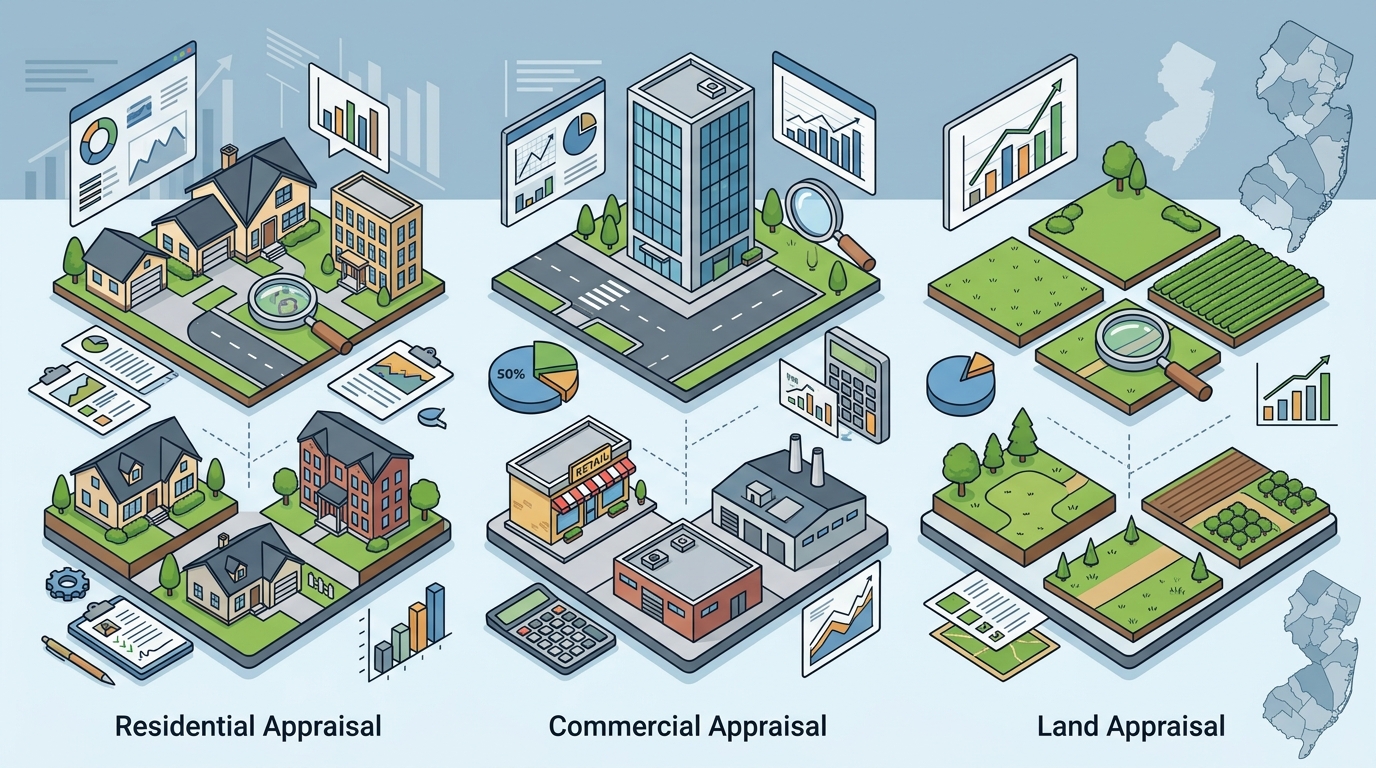
Understanding the differences between residential, commercial, and land appraisals is essential for choosing the right service. The table below summarizes the key distinctions.
| Appraisal Type | Primary Method | Key Data Points | Common Use Cases |
|---|---|---|---|
| Residential | Sales Comparison | Comparable sales, condition, location | Refinancing, purchase, divorce |
| Commercial | Income Capitalization | NOI, cap rates, lease terms | Investment analysis, lending |
| Land | Highest and Best Use | Zoning, topography, infrastructure | Development, estate, zoning |
Each appraisal type requires a different set of skills and data sources. Residential appraisals rely on neighborhood comparables, commercial appraisals on financial performance, and land appraisals on regulatory and physical potential.
When to Hire a State-Certified Appraiser
For any significant real estate transaction or legal matter in New Jersey, it is crucial to hire a state-certified appraiser. Automated valuation models (AVMs) and online estimates lack the nuance and local expertise required for accurate valuations. According to the Federal Housing Finance Agency, professional appraisals reduce the risk of over- or under-valuing properties, which can lead to financial losses or legal complications.
Our team at New Jersey Real Estate Appraisal Group brings over 26 years of experience to every appraisal. We provide transparent, straight-forward, no-nonsense service that adheres to the highest ethical standards. Whether you need a divorce appraisal, a tax appeal, or a date-of-death estate appraisal, we deliver court-ready reports that stand up to scrutiny.
Key Takeaways
- Residential appraisals use the sales comparison approach, focusing on comparable home sales.
- Commercial appraisals primarily use the income capitalization approach, analyzing revenue potential.
- Land appraisals determine value based on highest and best use, zoning, and infrastructure.
- New Jersey Real Estate Appraisal Group has over 26 years of experience serving all 21 counties.
- State-certified appraisers provide USPAP-compliant, court-ready valuations for legal and financial needs.
- Accurate appraisals are essential for divorce settlements, estate planning, and tax appeals.
- Our team offers fast turnaround times of 5-7 business days for appraisal reports.
Frequently Asked Questions
What is the difference between a residential and commercial appraisal?
Residential appraisals focus on comparable sales of similar homes, while commercial appraisals analyze the income-generating potential of the property. Commercial appraisals are more complex and require detailed financial data.
How long does a land appraisal take?
A land appraisal typically takes 5-7 business days after the inspection. The timeline may vary depending on the complexity of the zoning analysis and the size of the property.
Do I need a state-certified appraiser for a divorce?
Yes, New Jersey courts require unbiased, state-certified appraisals for divorce settlements to ensure equitable asset division. Our court-ready divorce appraisals are designed to meet these strict legal standards.
What is highest and best use in a land appraisal?
Highest and best use is the most profitable legal use of a vacant land parcel. It considers zoning, physical characteristics, and market demand to determine the land's maximum value.
Can you help with a property tax appeal?
Yes, we provide certified market value appraisals supported by in-depth data analysis for New Jersey county and tax board appeals. Our reports help property owners challenge inflated assessments.
How do you determine the value of a commercial property?
We use the income capitalization approach, analyzing net operating income, capitalization rates, and market rents. This method provides a defensible valuation for investors and lenders.
What documents do I need for an appraisal?
You will need to provide property deeds, recent tax bills, and any relevant lease agreements. Our appraiser will guide you through the specific requirements for your property type.
Request Your Appraisal Quote
Whether you need a residential, commercial, or land appraisal, New Jersey Real Estate Appraisal Group is here to help. Our state-certified appraisers provide accurate, USPAP-compliant valuations that meet the needs of homeowners, lenders, and legal professionals. Contact us today to get a fast quote and schedule your appraisal.
Get a Fast Quote or call us at 908-517-3913 to speak with our team.