

Settling an estate is one of the most complex administrative tasks a family can face. It involves not only emotional grief but also intricate legal and financial obligations. One of the most critical steps in this process is determining the fair market value of the deceased's assets. According to the Internal Revenue Service, accurate valuation is mandatory for calculating estate taxes, and errors can lead to significant penalties. This is where the role of a professional becomes indispensable. Many executors wonder if they can rely on online estimates or real estate agent opinions. The short answer is no. For court-ready documentation and IRS compliance, you need a state-certified appraiser who provides a defensible, unbiased opinion of value.
Why a Certified Appraiser is Mandatory
When you are settling an estate, the goal is to distribute assets fairly among beneficiaries and comply with federal and state laws. An estate appraisal is not merely a guess at what a house might sell for. It is a formal, documented opinion of value prepared by a licensed professional. New Jersey Real Estate Appraisal Group has served families across all 21 counties for over 26 years, providing valuations that stand up to scrutiny from the IRS, probate courts, and tax boards.
Why can't you just use the Zestimate or an agent's Comparative Market Analysis (CMA)? Online algorithms lack the nuance of physical inspection and local market dynamics. A CMA is designed to help you list a home for sale, not to provide a legally defensible valuation for tax or legal purposes. A state-certified appraiser adheres to the Uniform Standards of Professional Appraisal Practice (USPAP). This ensures the report is unbiased, independent, and accurate. For more on the importance of professional standards, you can review guidelines from the Appraisal Institute.
Understanding Date-of-Death Valuation
The cornerstone of any estate settlement is the "date-of-death" value. This is the fair market value of the property on the exact day the individual passed away. This number is crucial for two main reasons: estate tax calculation and step-up in basis.
Date-of-death value is the fair market price at which the property would change hands between a willing buyer and a willing seller on the date of the owner's death. If the estate exceeds the federal exemption threshold, the IRS requires this specific valuation to calculate the estate tax owed. Furthermore, heirs receive a "step-up" in basis. This means the cost basis of the property is adjusted to its date-of-death value. If the heirs later sell the property, they only pay capital gains tax on the appreciation that occurred after the death, not from the original purchase price. An accurate appraisal protects heirs from overpaying taxes.
For detailed IRS regulations on estate valuation, refer to IRS Publication 559.
Handling Property Tax Appeals
After the estate is settled, the new owners must deal with property taxes. In New Jersey, property assessments are often based on previous market conditions that may no longer reflect reality. If the county assessor's value is higher than the actual market value, the estate or the heirs may need to file a tax appeal.
A certified appraisal provides the necessary evidence to challenge an inflated assessment. New Jersey Real Estate Appraisal Group offers specialized certified property tax appeal appraisals that are supported by in-depth data analysis. These reports are tailored for county and tax board reviews, helping to lower the taxable value of the property. Without a professional report, tax appeals are often dismissed due to lack of credible evidence.
Residential vs. Commercial Property Needs
Estates often include a mix of assets. The appraisal approach for a single-family home differs significantly from that of a commercial income-producing property or vacant land.
| Property Type | Primary Valuation Approach | Key Considerations for Estate Settlement |
|---|---|---|
| Residential Home | Comparable Sales Approach | Recent sales of similar homes in the neighborhood; condition adjustments. |
| Commercial Property | Income Capitalization Approach | Rental income, vacancy rates, and operating expenses. |
| Vacant Land | Land Residual or Sales Comparison | Zoning potential, highest and best use, and development costs. |
For commercial properties, the valuation is more complex. It requires analyzing net operating income and capitalization rates. New Jersey Real Estate Appraisal Group provides state-certified commercial real estate appraisals for investors and lenders. These reports are essential for equitable distribution among heirs who may have different interests in the income stream versus the asset value.
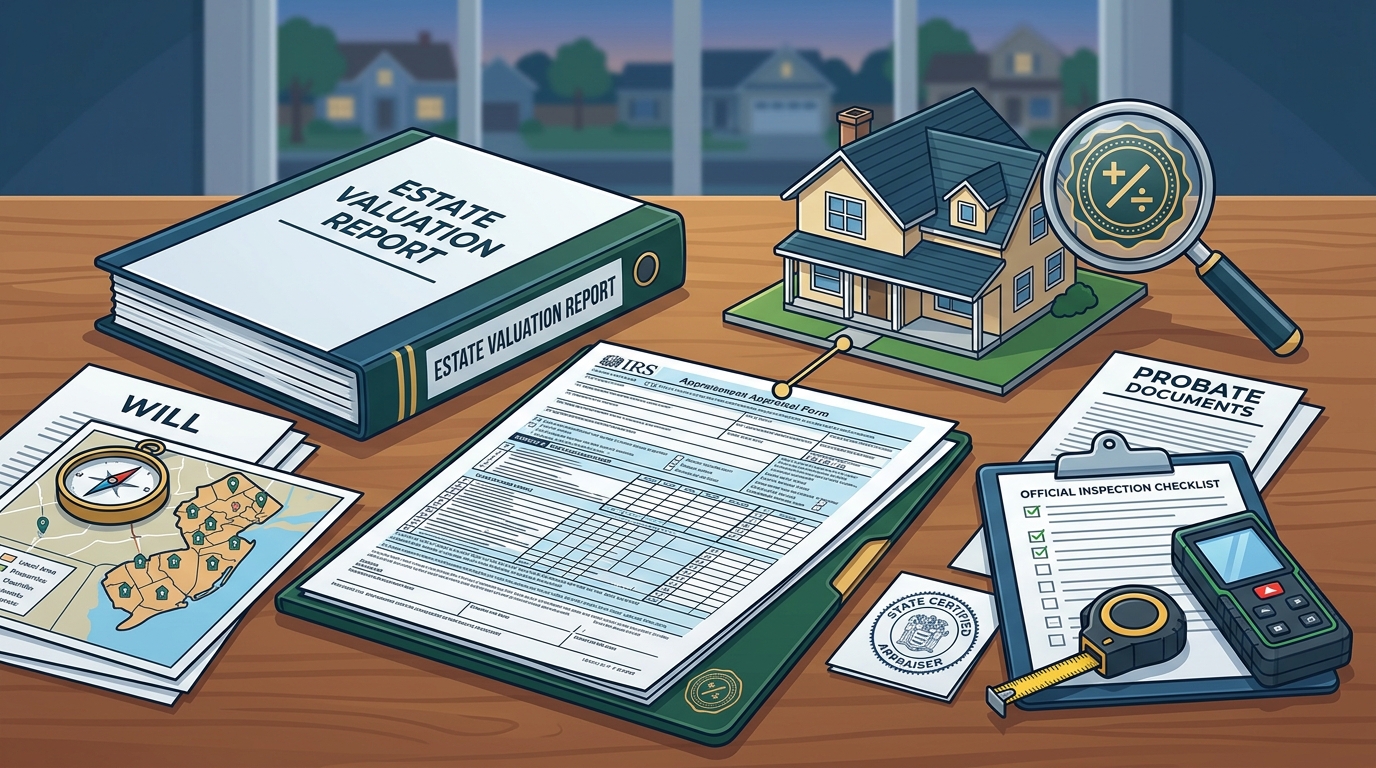
The Appraisal Process for Executors
As the executor of the estate, your role is to manage the process efficiently. Here is how the engagement typically works with a firm like NJREAG:
- Engagement: You contact a state-certified appraiser to discuss the specific needs of the estate. You can contact us to get a fast quote.
- Inspection: The appraiser visits the property to document its condition, size, and features. This is not a home inspection; it is a valuation-focused walkthrough.
- Analysis: The appraiser researches comparable sales, market trends, and income data. They apply professional judgment to determine the value.
- Report Delivery: You receive a comprehensive, USPAP-compliant report. NJREAG typically provides a turnaround time of 5-7 business days following the inspection.
This process ensures that the valuation is not only accurate but also defensible in court or before the IRS. For more insights on preparing for an appraisal, read our expert articles on home appraisals.
Key Takeaways
- Legal Requirement: The IRS and probate courts require valuations from state-certified appraisers, not online estimates.
- Date-of-Death Value: This specific valuation is critical for calculating estate taxes and establishing the step-up in basis for heirs.
- USPAP Compliance: Reports must adhere to Uniform Standards of Professional Appraisal Practice to be accepted by regulatory bodies.
- Tax Appeal Support: A professional appraisal is often necessary to challenge inflated county property assessments in New Jersey.
- Speed and Accuracy: NJREAG provides court-ready reports within 5-7 business days, ensuring timely estate settlement.
- Comprehensive Coverage: Services include residential, commercial, and land appraisals across all 21 New Jersey counties.
- Expertise: Over 26 years of experience ensures deep local market knowledge and defensible valuations.
Frequently Asked Questions
Can I use a real estate agent's opinion for estate taxes?
No. While an agent's opinion can be helpful for listing a home, it is not a formal appraisal. The IRS requires a valuation from a qualified, state-certified appraiser to ensure objectivity and accuracy.
What is the difference between a date-of-death appraisal and a current market appraisal?
A date-of-death appraisal determines the value on the specific day the owner passed away, which is required for tax purposes. A current market appraisal reflects the value at the time of the report, which is useful for sales or refinancing.
How long does it take to get an estate appraisal report?
At NJREAG, we typically deliver comprehensive reports within 5-7 business days after the property inspection. This rapid turnaround helps executors meet legal deadlines.
Do you appraise commercial properties for estates?
Yes. We provide state-certified commercial appraisals for income-producing properties, which are essential for valuing business assets or rental portfolios within an estate.
Is the appraisal report accepted by New Jersey tax boards?
Yes. Our reports are USPAP-compliant and specifically tailored to meet the standards of New Jersey county tax boards for property tax appeals.
What if the estate includes vacant land?
We provide certified land appraisals that analyze zoning, highest and best use, and comparable land sales to determine the true value of vacant property.
Can I get an appraisal for a home in a different county?
Absolutely. NJREAG serves all 21 counties in New Jersey, including Atlantic, Bergen, Burlington, Camden, and Morris, among others.
What is USPAP compliance?
USPAP stands for Uniform Standards of Professional Appraisal Practice. It is the generally accepted ethical and performance standards for the appraisal profession in the United States.
Request Your Estate Appraisal
Do not leave the valuation of your loved one's estate to chance. Ensure fairness, compliance, and peace of mind by engaging a state-certified professional. New Jersey Real Estate Appraisal Group is ready to assist you with accurate, court-ready valuations. Contact us today to schedule your inspection or request a fast quote. You can also call or text us at 908-517-3913.