

Can I Get a Court-Ready Appraisal for a Divorce Settlement in New Jersey?
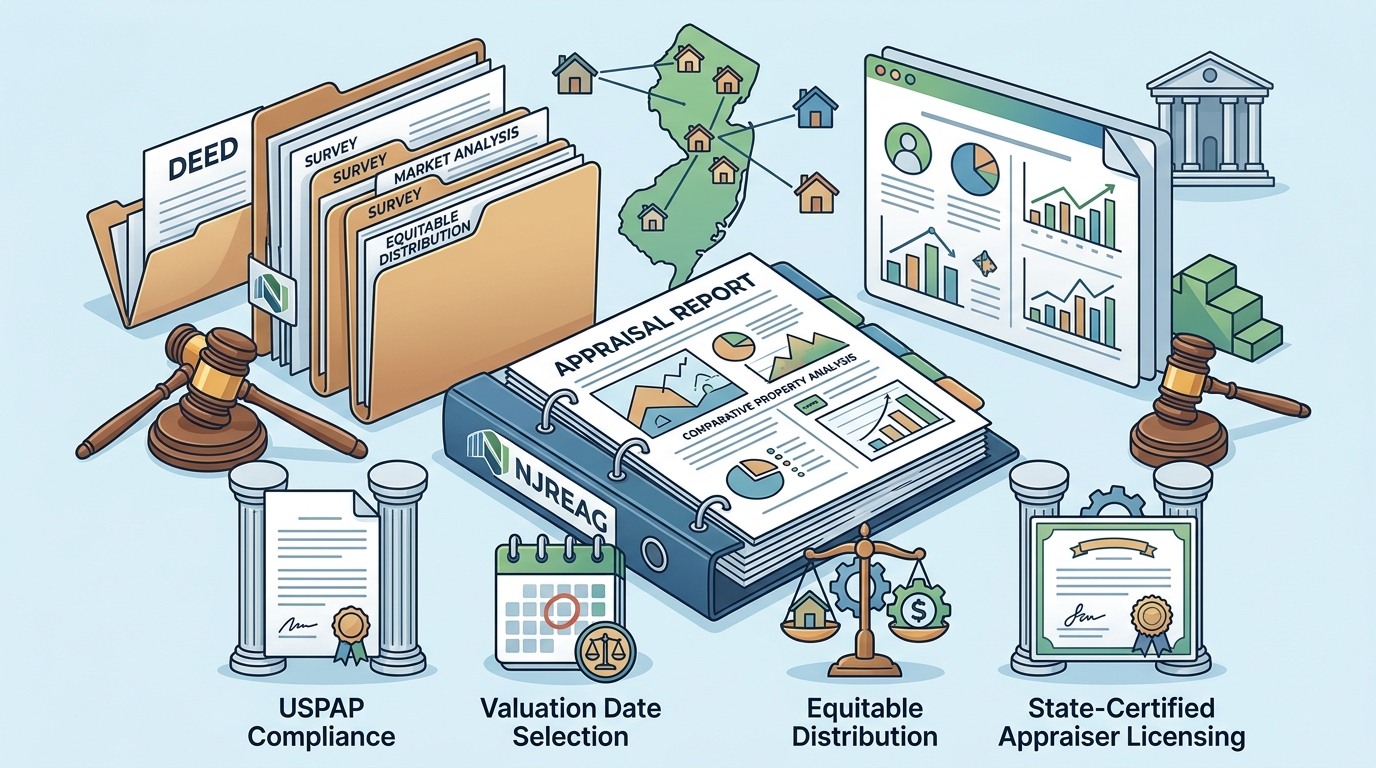
Yes, you can obtain a court-ready appraisal for a divorce settlement in New Jersey. New Jersey Real Estate Appraisal Group provides state-certified, USPAP-compliant valuations specifically designed for equitable distribution proceedings. This guide covers the four critical pillars of a defensible divorce appraisal: strict adherence to Uniform Standards of Professional Appraisal Practice (USPAP), the legal selection of the valuation date, the state's equitable distribution framework, and the specific licensing requirements for certified appraisers.
USPAP Compliance in Divorce Appraisals
USPAP compliance is the non-negotiable foundation of any appraisal intended for legal proceedings. The Uniform Standards of Professional Appraisal Practice is the national code of ethics and standards for the appraisal profession. In the context of a divorce, a USPAP-compliant report ensures that the valuation is objective, independent, and free from bias. Courts in New Jersey require that any real estate evidence presented for equitable distribution meets these professional standards to be admissible.
Why Courts Reject Non-Compliant Reports
Judges and family law attorneys frequently reject valuations prepared by real estate agents, automated valuation models (AVMs), or unlicensed consultants. These sources often lack the rigorous documentation and ethical constraints required by the law. A certified appraisal report must clearly state the scope of work, the methods used, and the appraiser's qualifications. Without this transparency, the opposing party can easily challenge the credibility of the value opinion, leading to delays and increased legal costs.
The Role of Independence
Independence is the core ethical requirement of USPAP. An appraiser must not be influenced by the outcome of the case or the financial interests of either spouse. New Jersey Real Estate Appraisal Group maintains strict neutrality in all divorce assignments. This independence ensures that the value opinion is based solely on market data and property condition, not on the desires of the client. For a settlement to hold up in court, the valuation must be defensible against cross-examination.
Valuation Date Selection in New Jersey
The valuation date is the specific point in time for which the property value is determined. In New Jersey divorce proceedings, the choice of valuation date is a critical legal decision that can significantly impact the final asset division. The most common dates used are the date of the divorce filing, the date of separation, or the date of trial. Each date carries different implications for how the property's value is calculated and how subsequent changes in the market are treated.
Retrospective Valuation Challenges
When a divorce is contested and takes months or years to resolve, the property value at the time of filing may differ substantially from the value at the time of trial. A retrospective appraisal determines what the property was worth on a specific past date. This requires the appraiser to analyze market conditions, comparable sales, and property condition as they existed at that historical moment. It is a complex task that requires deep local market knowledge and access to historical data.
Impact on Equitable Distribution
The selection of the valuation date directly affects the dollar amount available for distribution. If the market has risen since the filing date, using the trial date may result in a higher total asset pool. Conversely, if the market has declined, the filing date may be more favorable. New Jersey courts have discretion in selecting the appropriate date, but the parties and their attorneys must agree on the standard to be used. A certified appraiser can provide valuations for multiple dates to help the court make an informed decision.
The Equitable Distribution Framework
New Jersey is an equitable distribution state, which means that marital assets are divided fairly, but not necessarily equally. The court considers various factors when dividing property, including the length of the marriage, the income and earning capacity of each spouse, and the contribution of each party to the acquisition of the assets. Real estate is often the largest single asset in a divorce, making its accurate valuation essential to a fair outcome.
Marital vs. Separate Property
Before an appraisal can be used for distribution, the property must be classified as either marital or separate property. Marital property is generally acquired during the marriage and is subject to equitable distribution. Separate property, such as assets owned before the marriage or received by inheritance, is typically excluded from distribution. However, if separate property has been commingled with marital funds or has appreciated in value due to marital efforts, it may be partially subject to distribution. An appraisal helps quantify the value of the marital portion of the asset.
Buyout and Offset Strategies
In many New Jersey divorces, one spouse seeks to keep the marital home while the other receives other assets of equivalent value. This is known as a buyout or offset. To execute a buyout, the spouse retaining the home must determine the exact value of the property to calculate the cash payment owed to the other spouse. A court-ready appraisal provides the neutral, third-party value needed to structure this payment. It also helps the retaining spouse determine if they can qualify for a new mortgage based on the appraised value.
Certified Appraiser Requirements
Not all appraisers are qualified to handle complex divorce cases. New Jersey requires appraisers to be licensed or certified by the state to perform real estate valuations. A certified appraiser has met higher education, experience, and examination requirements than a licensed appraiser. For residential properties, a state-certified residential appraiser is typically sufficient. However, for complex properties or those with significant commercial components, a general certified appraiser may be required.
Licensing and Certification Levels
The New Jersey Real Estate Appraiser Board oversees the licensing of appraisers in the state. There are two main levels of certification: Residential and General. A Residential certification allows an appraiser to value single-family homes up to a certain complexity level. A General certification allows an appraiser to value all types of real property, including commercial, industrial, and agricultural. For a divorce involving a primary residence, a state-certified residential appraiser is usually appropriate. New Jersey Real Estate Appraisal Group employs state-certified appraisers who meet these rigorous standards.
Experience and Local Market Knowledge
Beyond licensing, experience and local market knowledge are crucial for a defensible appraisal. An appraiser who is familiar with the specific neighborhood, school district, and local market trends can provide a more accurate and defensible value opinion. In New Jersey, where property values can vary significantly from one township to the next, local expertise is essential. A certified appraiser with deep roots in the local market can identify the most appropriate comparable sales and make accurate adjustments for differences in condition, location, and features.
Comparison of Valuation Methods in Divorce
| Method | Court Acceptability | Typical Use Case | Key Limitation |
|---|---|---|---|
| Certified Appraisal | High | Contested divorce, buyouts, court proceedings | Cost and time |
| Comparative Market Analysis (CMA) | Low | Informal negotiations, listing pricing | Not admissible in court |
| Automated Valuation Model (AVM) | Very Low | Initial estimates, lender screening | Lacks property-specific inspection |
Key Takeaways
- USPAP compliance is mandatory for any appraisal to be considered court-ready in New Jersey.
- The valuation date is a critical legal decision that affects the total asset pool available for distribution.
- New Jersey uses an equitable distribution framework, meaning assets are divided fairly, not necessarily equally.
- State-certified appraisers are required to ensure the valuation meets professional and legal standards.
- Automated valuation models and real estate agent estimates are generally not admissible in court.
- Local market knowledge is essential for accurate and defensible valuations in New Jersey.
- A neutral, third-party appraisal helps reduce disputes and facilitates a smoother settlement process.
- Consulting with a family law attorney early in the process ensures the appraisal meets the specific needs of the case.
Frequently Asked Questions
What is the difference between a certified appraisal and a home inspection?
A certified appraisal determines the market value of a property, while a home inspection assesses the physical condition of the property. An appraisal is a valuation opinion, whereas an inspection is a diagnostic report. In a divorce, both may be needed, but only the appraisal is used for equitable distribution.
Can I use a Zillow estimate for my divorce settlement?
No, Zillow estimates are automated valuation models (AVMs) and are not admissible in court. They do not account for the specific condition of the property or local market nuances. A certified appraisal is required for a court-ready valuation.
How long does a divorce appraisal take in New Jersey?
A typical divorce appraisal takes 5 to 7 business days after the inspection. However, complex cases or retrospective valuations may take longer. Rush services are often available for urgent court deadlines.
Who pays for the appraisal in a divorce?
The cost of the appraisal is typically shared equally by both spouses, or it may be paid by the spouse who requests it. The final allocation of costs is often determined by the court or agreed upon in the settlement.
Can I challenge an appraisal if I disagree with the value?
Yes, you can challenge an appraisal by requesting a second opinion or by presenting additional evidence to the court. However, the court will generally rely on the certified appraisal unless it is shown to be flawed or biased.
What documents do I need to provide for a divorce appraisal?
You will need to provide the property address, the date of the divorce filing, and any relevant legal documents. The appraiser will also need access to the property for an interior and exterior inspection.
Is an appraisal the same as a tax assessment?
No, an appraisal determines market value, while a tax assessment determines the value for property tax purposes. These two values can differ significantly. A tax assessment is not a substitute for a market value appraisal in a divorce.
Can an appraiser testify in court?
Yes, a certified appraiser can be called as an expert witness to testify about their valuation opinion. This is common in contested divorces where the value of the property is disputed.
Conclusion
Obtaining a court-ready appraisal for a divorce settlement in New Jersey is a critical step in ensuring a fair and defensible division of assets. By adhering to USPAP standards, selecting the appropriate valuation date, understanding the equitable distribution framework, and working with a state-certified appraiser, you can protect your interests and facilitate a smoother legal process. New Jersey Real Estate Appraisal Group is committed to providing accurate, unbiased, and court-ready valuations for all your divorce-related appraisal needs. Contact us today to schedule your appraisal and take the next step toward a fair settlement.