

Property valuation is not a one-size-fits-all process. While the goal remains the same across all sectors, the methodologies used to determine market value differ significantly between residential and commercial real estate. According to the Appraisal Institute, the fundamental approaches to value are the Sales Comparison, Cost, and Income approaches, but their application varies by property type. Understanding these distinctions is critical for homeowners, investors, and legal professionals navigating New Jersey's complex real estate landscape. (About NJREAG New Jersey)
Residential Appraisal Methodology
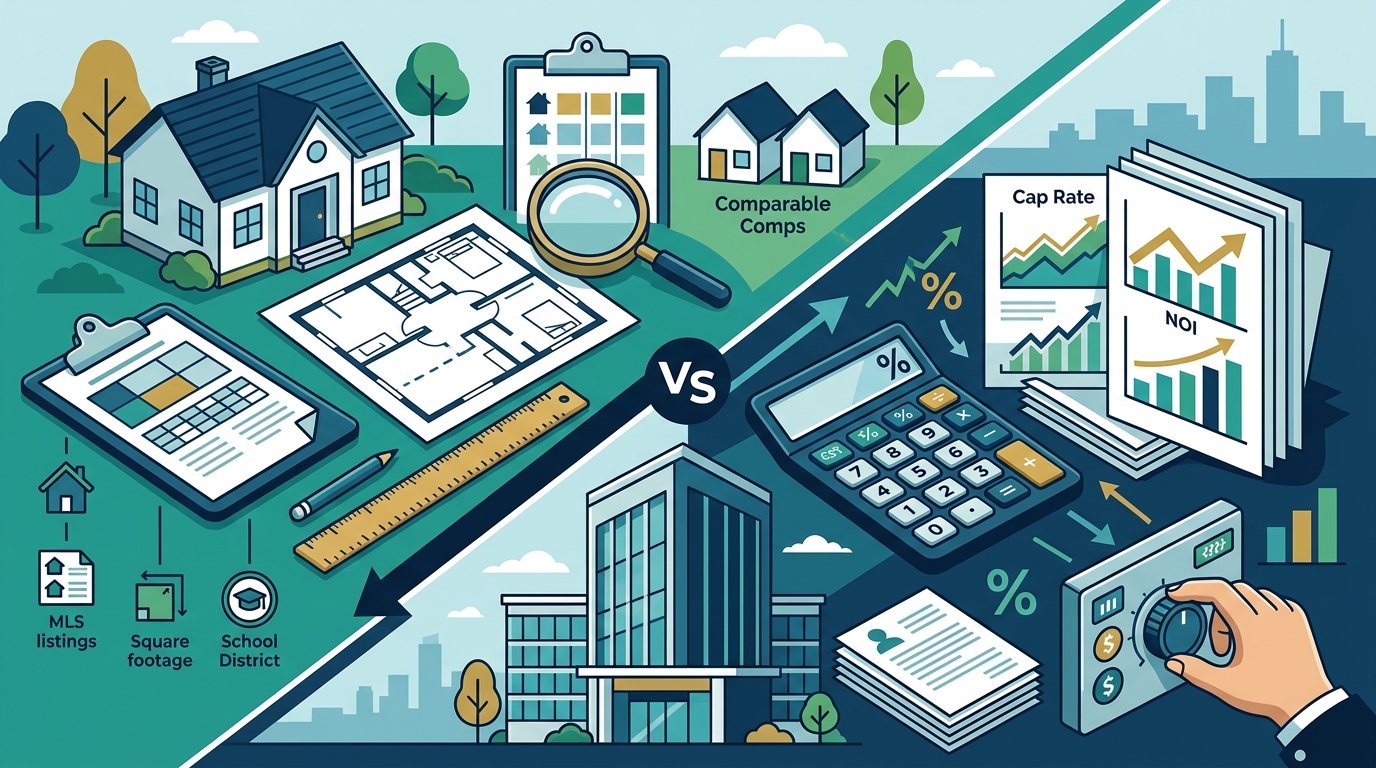
Residential appraisals focus primarily on single-family homes, condominiums, and multi-unit properties up to four units. The dominant method used in this sector is the Sales Comparison Approach. This method relies on analyzing recent sales of comparable properties in the immediate vicinity. Appraisers look for "comps" that share similar square footage, age, condition, and amenities. (Bergen County NJ Appraisals)
In New Jersey, this process is highly localized. A state-certified appraiser must understand the micro-markets of counties like Middlesex, Bergen, and Monmouth. For example, a home in Edison may have different value drivers than one in nearby Piscataway due to school districts and zoning regulations. The Sales Comparison Approach is preferred because residential buyers are typically motivated by lifestyle and utility rather than investment returns. (Camden County NJ Appraisals)
The Cost Approach is also used in residential appraisals, particularly for new construction or unique properties with no recent comparable sales. This method estimates the cost to replace the structure minus depreciation, plus the land value. However, it is secondary to the Sales Comparison Approach in most standard residential transactions.
Commercial Appraisal Methodology
Commercial real estate appraisals serve a different purpose. They are used for office buildings, retail centers, industrial warehouses, and income-producing multi-family properties. The primary driver here is not just the physical structure, but the income it generates. Consequently, the Income Capitalization Approach is the cornerstone of commercial valuation.
The Income Approach calculates value based on the net operating income (NOI) and a capitalization rate. This method reflects the investor's perspective, focusing on cash flow potential. For instance, a retail property in Atlantic County might be valued differently than one in Camden based on foot traffic data and lease terms. Lenders rely heavily on this data to assess risk and determine loan-to-value ratios.
While the Sales Comparison Approach is still relevant for commercial properties, it is often used to support the Income Approach. The Cost Approach is less common in commercial valuation because depreciation is harder to quantify accurately for large-scale structures. Instead, appraisers focus on the economic life of the building and its current marketability.
Key Differences in Approach
The divergence between residential and commercial appraisals lies in the weight given to different valuation methods. Residential appraisals are heavily reliant on recent transaction data. Commercial appraisals are heavily reliant on financial performance and market rent data.
Another critical difference is the complexity of the analysis. Commercial appraisals often require detailed financial statements, lease abstracts, and market rent surveys. Residential appraisals rely more on physical characteristics and recent sales of similar homes. This makes commercial appraisals more subjective and dependent on the appraiser's understanding of market trends and investor behavior.
Furthermore, the regulatory scrutiny differs. While both must adhere to Uniform Standards of Professional Appraisal Practice (USPAP), commercial appraisals often face additional scrutiny from lenders and investors who demand a deeper dive into the property's financial health. This includes analyzing vacancy rates, operating expenses, and future capital expenditures.
Regulatory Standards and USPAP
All appraisals in the United States must comply with the Uniform Standards of Professional Appraisal Practice (USPAP). These standards ensure that appraisers maintain objectivity, independence, and confidentiality. In New Jersey, appraisers must also be licensed or certified by the state.
For residential appraisals, the focus is on ensuring the valuation is defensible in legal contexts, such as divorce settlements or estate probate. The appraiser must provide a clear chain of evidence linking the final value opinion to the comparable sales data. This is crucial for court-ready reports that may be challenged in mediation or litigation.
Commercial appraisals, while also bound by USPAP, often require a more extensive report format. The Uniform Commercial Appraisal Report (UCAR) is commonly used for complex commercial properties. This report provides a detailed narrative of the market analysis, highest and best use analysis, and income projections. It is designed to give investors and lenders a comprehensive view of the property's value drivers.
Service Comparison Table
The following table summarizes the key differences between residential and commercial appraisal services offered by New Jersey Real Estate Appraisal Group.
| Feature | Residential Appraisal | Commercial Appraisal |
|---|---|---|
| Primary Method | Sales Comparison Approach | Income Capitalization Approach |
| Property Types | Single-family, Condos, 2-4 Units | Office, Retail, Industrial, 5+ Units |
| Data Focus | Recent Comparable Sales | Net Operating Income, Cap Rates |
| Report Complexity | Standard Residential Report | Uniform Commercial Appraisal Report |
| Common Use Cases | Refinancing, Divorce, Estate | Investment Analysis, Lending, Development |
Key Takeaways
- Residential appraisals primarily use the Sales Comparison Approach, relying on recent sales of similar homes in the neighborhood.
- Commercial appraisals primarily use the Income Capitalization Approach, focusing on the property's ability to generate net operating income.
- Both residential and commercial appraisals must adhere to USPAP standards and state licensing requirements in New Jersey.
- Commercial appraisals are more complex, often requiring detailed financial analysis and lease abstracts.
- Residential appraisals are critical for legal matters such as divorce settlements and estate probate in New Jersey.
- New Jersey Real Estate Appraisal Group has over 26 years of experience serving all 21 counties in the state.
- Turnaround time for appraisal reports is typically 5-7 business days following the property inspection.
Frequently Asked Questions
What is the difference between a residential and commercial appraisal?
A residential appraisal focuses on the value of a home based on recent sales of comparable properties, while a commercial appraisal focuses on the income potential of the property using the Income Capitalization Approach.
Do I need a state-certified appraiser in New Jersey?
Yes, for most lending and legal purposes, you must use a state-certified appraiser who is licensed by the New Jersey Real Estate Appraisal Commission and adheres to USPAP standards.
How long does it take to get an appraisal report?
New Jersey Real Estate Appraisal Group typically delivers reports within 5-7 business days after the property inspection is completed.
Can an appraiser value both residential and commercial properties?
Yes, many state-certified appraisers are qualified to value both types of properties, but they must have specific competency in the relevant market and property type.
What is USPAP?
USPAP stands for Uniform Standards of Professional Appraisal Practice. It is the generally accepted ethical and performance standards for the appraisal profession in the United States.
Why is an appraisal needed for a divorce in New Jersey?
An appraisal provides an unbiased, court-ready valuation of the marital home, ensuring equitable asset division between spouses.
What is the Cost Approach in appraisal?
The Cost Approach estimates the value of a property by calculating the cost to replace the structure minus depreciation, plus the land value.
Get Your Professional Appraisal
Whether you need a precise valuation for a divorce settlement, a commercial investment analysis, or a tax appeal, accurate data is essential. New Jersey Real Estate Appraisal Group provides state-certified, USPAP-compliant reports tailored to your specific needs. Contact us today to schedule your appraisal or request a fast quote.
Visit our homepage to learn more about our services or contact us directly to get started.